Development economics · Humanitarian early warning · Applied NLP
Turning bilingual news into an auditable food-crisis verification queue
I designed a research prototype that converts English and Arabic news into location-level evidence for food-insecurity monitoring across Iraq, Jordan, Lebanon, Palestine, and Syria. The system helps analysts decide where to investigate—not whether a crisis exists.
The question
Can fast-moving news strengthen food-security surveillance when outcome data arrive late?
Food crises are local, dynamic, and costly to miss. Yet the classifications used to measure food insecurity are often released less frequently than news. Articles can surface drought, price pressure, conflict, displacement, crop failure, and access constraints sooner—but media signals are noisy, unevenly distributed, and easy to over-interpret.
The objective was therefore not to label places as “in crisis.” It was to create a transparent screening tool that ranks locations for analyst verification, preserves the evidence behind every flag, and can later be tested against future IPC or Cadre Harmonisé outcomes.
Design principles
The constraints became part of the methodology
No labels, no false precision
With one month of articles and no food-security outcome, a supervised model would not be credible. I built an evidence index and a leakage-safe evaluation plan instead.
English and Arabic stay visible
Language-specific retrieval is reported separately before signals are combined, making coverage gaps and translation risk inspectable.
Every score links back to evidence
Analysts can inspect the article, source, language, matched phrase, theme, and location behind a flag before escalating it.
Methodology
From raw articles to a policy-facing review queue
-
01
Audit and repair the taxonomy
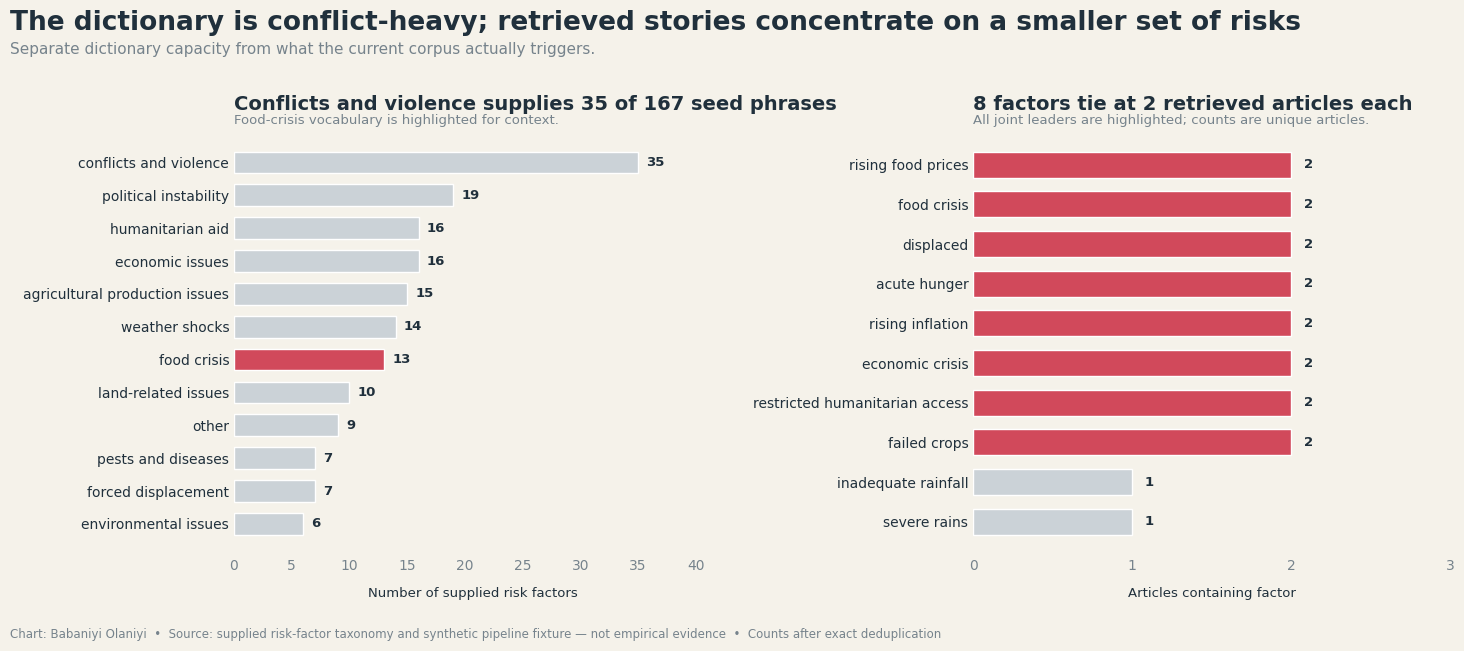
I standardized punctuation and encoding, repaired a malformed coup d’état entry that broke the category join, and validated all 167 factors against 12 themes.
-
02
Build a reproducible bilingual seed lexicon
The supplied Arabic column was empty. I added one deterministic Arabic seed phrase per factor, normalized diacritics and common spelling variants, and documented the need for native-speaker adjudication and dialect expansion.
-
03
Retrieve phrases without substring leakage
A longest-first token n-gram matcher prevents a term such as rise from matching surprise or being double-counted inside price rise. Exact hashes remove duplicate articles.
-
04
Resolve geography conservatively
Articles are matched to the supplied country, province, and district aliases. The resolver keeps the most specific unambiguous location and falls back to a shared parent rather than inventing precision.
-
05
Separate signal from confidence
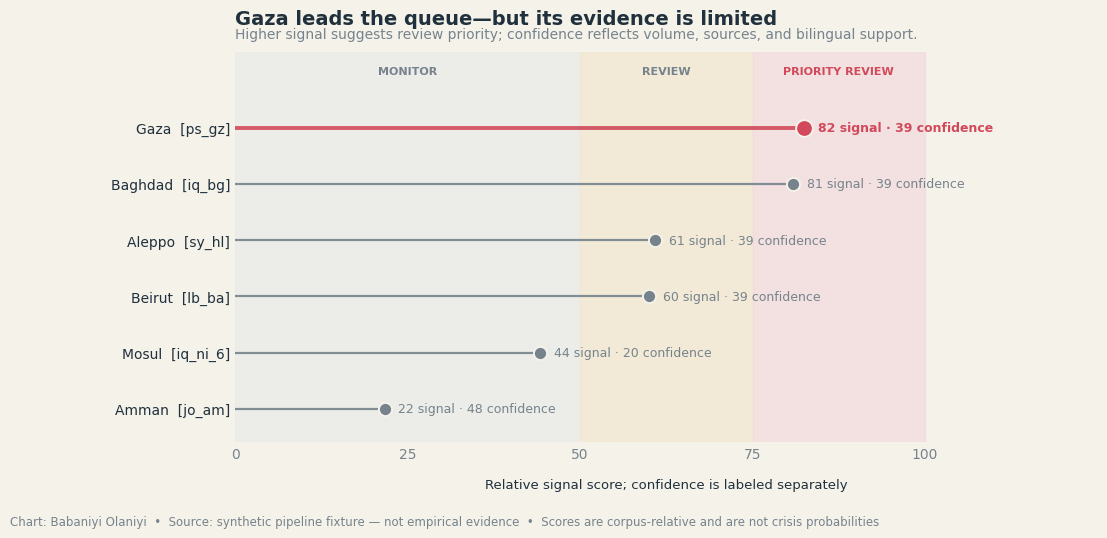
A beta-binomial empirical-Bayes model partially pools sparse locations. The signal score summarizes risk prevalence, mention intensity, and thematic breadth; confidence separately reflects article volume, source diversity, and bilingual support.
-
06
Connect prediction to decisions
The analysis applies a cost-sensitive prevention framework: a desk review, field verification, and material intervention should each have different thresholds because their costs and effectiveness differ.
Analytical workflow
Four steps turn reporting into a review queue
- 01 Inputs News, risk taxonomy and place names
- 02 Measure Bilingual phrase and location matching
- 03 Estimate Partially pooled location-level signals
- 04 Act Evidence-linked analyst review queue
Results
A complete measurement prototype—with an explicit boundary on what it proves
What the implementation delivered
- All 167 risk factors retained, categorized, and assigned an Arabic seed phrase.
- Hierarchical matching across 357 countries, provinces, and districts.
- Article-level evidence tables and bilingual retrieval diagnostics.
- A location ranking with uncertainty, source diversity, and language corroboration.
- Robustness tests across multiple empirical-Bayes prior strengths.
- An operational plan for forward validation, calibration, monitoring, and governance.
From prototype to forecast
How I would test whether news adds value
Build a vintage-correct district-month panel
Join future IPC/CH outcomes to lagged news, crisis history, food prices, CHIRPS rainfall, vegetation anomalies, conflict and humanitarian-access events, displacement, population, seasonality, and neighboring-district signals.
Compare nested baselines
Evaluate prevalence-only, crisis-history, structured-only, news-only, and combined models. The relevant claim is the incremental performance of news over history and structured early-warning data.
Validate forward in time and across space
Use expanding time windows and geographic holdouts. Report precision-recall performance, top-K recall under analyst capacity, Brier score, calibration, and country/language subgroups.
Choose thresholds from policy costs
Translate calibrated risk into actions using intervention cost, effectiveness, and the cost of a missed crisis. Monitor source outages, media imbalance, geographic coverage, and score drift after deployment.
Why this work matters
Relevance to development institutions
The project connects text-as-data, spatial targeting, uncertainty, and decision theory to a real operational problem. It is designed for settings where timeliness matters, labels are scarce, and false confidence can misallocate limited attention or resources.
Capabilities demonstrated
More work
Explore more applied data projects
Return to the portfolio for more work at the intersection of development economics, policy, and data science.